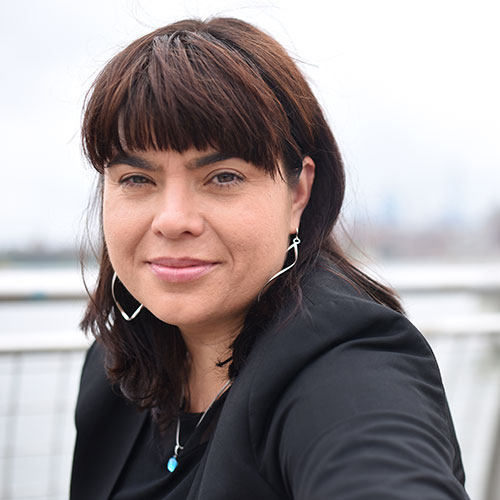
Hilke Schellmann
Associate Professor
Email: hilke.schellmann@nyu.edu
Author, Journalist, Full time Faculty
Hilke Schellmann is an Emmy Award–winning investigative reporter and associate professor of journalism at New York University. In 2025–2026 she was a Visiting Professional at Princeton University’s Center for Information Technology Policy, where she is now a Visiting Research Collaborator.
She is a frequent public speaker and gave the TEDAI talk “Will AI hire you for your next job?” Her talks cover AI (accountability) and its effects on society, the future of information and journalism, investigative reporting methods and public scholarship.
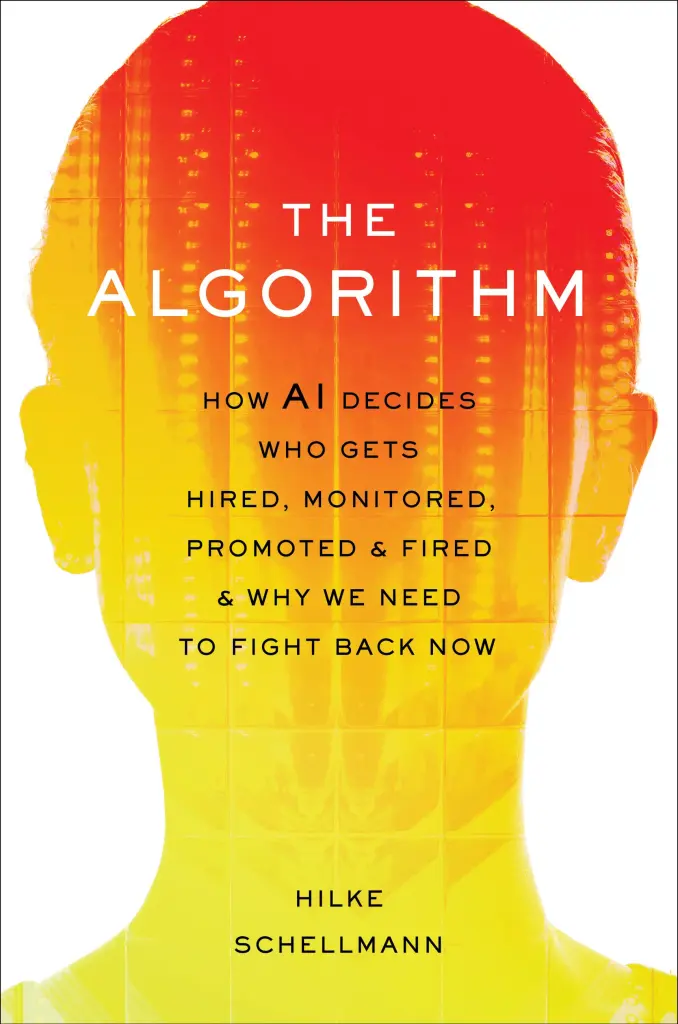
As a contributor to The Wall Street Journal and The Guardian, Schellmann writes about holding artificial intelligence (AI) accountable. In her book, The Algorithm: How AI Decides Who Gets Hired, Monitored, Promoted, and Fired, and Why We Need to Fight Back (Hachette), she investigates the rise of AI in the world of work. Drawing on exclusive information from whistleblowers, internal documents, and real-world tests, Schellmann finds that many of the algorithms making high-stakes decisions are biased, racist, and do more harm than good. The Algorithm was named one of the five best books about artificial intelligence by The New York Times and a Financial Times Best Book of the Year in 2024. It also won an Anthem Award, was a finalist in SABEW’s 2024 Best in Business Book Awards, and was longlisted for the Financial Times and Schroders Business Book of the Year Award.
With The Associated Press, Schellmann broke the story that OpenAI’s transcription tool Whisper fabricates text that was never spoken — including in hospitals using it to transcribe patient visits — an investigation that was picked up across legacy and tech media and inspired a storyline on HBO’s The Pitt. For The Guardian, she and Gianluca Mauro tested content-moderation algorithms sold by Microsoft, Google, and Amazon, and found that they rate images of women as more sexually suggestive than comparable images of men — a bias that can quietly suppress or shadowban the reach of women’s posts on social media. Her four-part investigative podcast and print series on AI and hiring for MIT Technology Review was a finalist for a Webby Award.
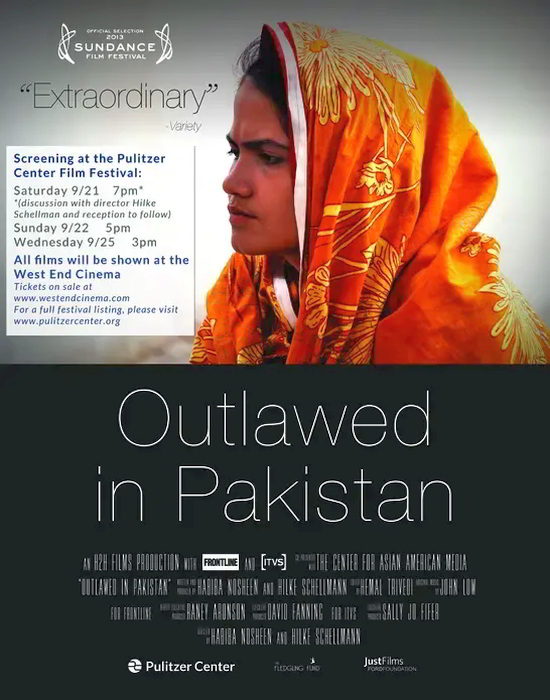
She directed, produced and shot the documentary Outlawed in Pakistan, which premiered at the 2013 Sundance Film Festival and was called “among the standouts” by the Los Angeles Times. The film screened at the International Documentary Film Festival Amsterdam (IDFA), and a longer version aired on PBS FRONTLINE, winning an Emmy, an Overseas Press Club Award, and a Cinema for Peace Award, among others.
In her investigation into student loans for VICE on HBO, she uncovered how a spigot of easy money from the federal government is driving up the cost of higher education in the U.S. and even threatening the country’s international competitiveness. The documentary was named a 2017 finalist for the Peabody Awards.
Schellmann was a showrunner and reporter for Moving Upstream, the Wall Street Journal’s in-depth video series, for which she for the first time combined investigative reporting with an immersive documentary style.
Earlier, as a multimedia reporter for the paper’s New York section, she spearheaded its video coverage. She has reported for NPR’s Planet Money on fake online reviews, and is a former Director of Video Journalism at Columbia University’s Graduate School of Journalism, where she also taught. Her work has appeared in publications including The New York Times, VICE on HBO, Scientific American, PBS, TIME, ARD, ZDF, WNYC, NPR, National Geographic, The Guardian, Glamour, and The Atlantic.
Schellmann has developed a model of public scholarship that brings journalistic questions into interdisciplinary academic research, using the methods of each to produce new knowledge about algorithmic systems and carry it back to a general audience. Her peer-reviewed research on algorithmic auditing has been published in Nature Machine Intelligence, Data Mining and Knowledge Discovery, and the proceedings of the ACM Conference on Fairness, Accountability, and Transparency (FAccT) and the AAAI/ACM Conference on AI, Ethics, and Society (AIES). It covers audits of algorithmic personality tests used in hiring and of speech-to-text systems that hallucinate content never spoken.
Schellmann was a Pulitzer Center AI Accountability Fellow and a 2022 Knight Science Journalism Fellow at MIT. Her work has been generously supported by the Patrick J. McGovern Foundation and the NYU Journalism Venture Capital Fund.
Published Articles & Essays