
Join a Small Group of Journalists Dedicated to Exploring International or Transnational Issues
In NYU Journalism’s Global & Joint Program Studies, students gain rigorous journalistic training alongside in-depth contextual study of a specific region or culture in a joint MA degree with one of eight internationally focused master’s programs. With just 15 students per cohort and exposure and training in myriad media platforms, Global and Joint Program Studies students graduate with a fluency in journalistic methods and an exceptionally rich base of knowledge in a region or culture.
A Journalism Degree Enriched with In-Depth Regional Study
Global and Joint Program Studies students enroll in a joint-degree program in one of eight internationally focused master’s programs at NYU: Africana Studies, French Studies, Latin American and Caribbean Studies, Near Eastern Studies, Russian and Slavic Studies, European and Mediterranean Studies, East Asian Studies, or International Relations. As a cohort, they take rigorous reporting and writing courses together at the Arthur L. Carter Journalism Institute, then they explore their specialized area in depth in their individual programs, culminating in a 7,000- to 10,000-word professional-quality journalistic work.
Faculty
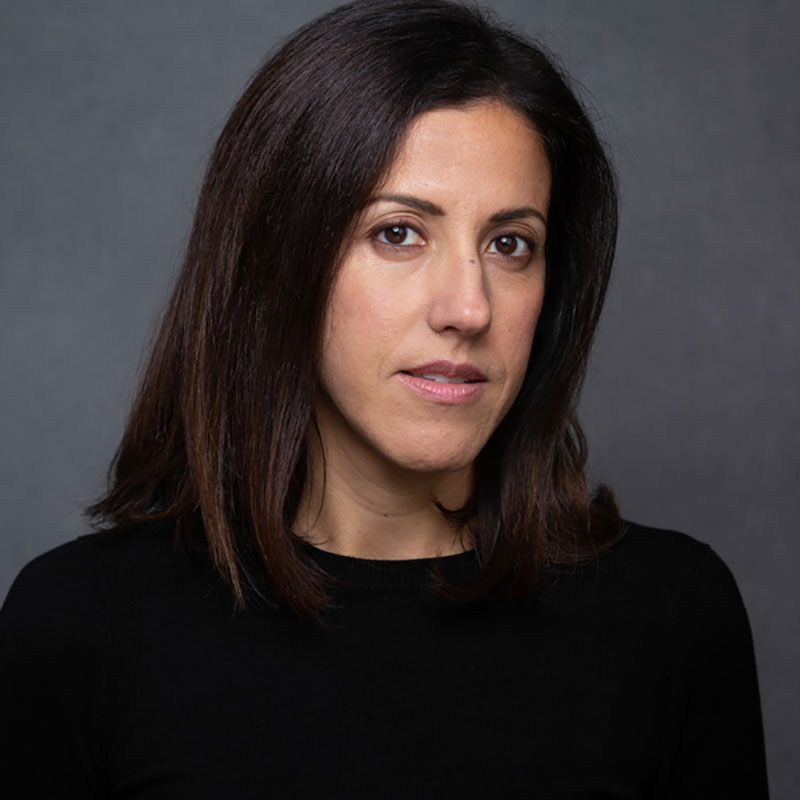
Azadeh Moaveni
Associate Professor | Global and Joint Program Studies, Director
Azadeh Moaveni is a journalist, writer and associate professor at NYU, where she directs the Global Journalism Program. Her books and articles explore the interaction between gender and armed conflict, and how women’s rights, security and political participation are impacted by war and authoritarianism. Her recent research has focused on women’s recruitment to armed groups, feminist foreign policy, and the humanitarian crisis arising from Russia’s invasion of Ukraine.
As a correspondent for the Los Angeles Times and Time Magazine, she covered the wars in Iraq and Afghanistan, and has reported from Egypt, Iran, Lebanon, Syria, and Tunisia. She is the author of two books on Iran, Lipstick Jihad, and Honeymoon in Tehran, and co-author, with Iranian Nobel Peace Laureate Shirin Ebadi, of Iran Awakening. Her latest book, Guest House for Young Widows: Among the Women of ISIS, was shortlisted for the Baillie Gifford Prize, the Rathbones Folio prize, and was a New York Times Notable Book of 2019. Guest House for Young Widows emerged out of a front-page story for the Times that was a finalist for a group Pulitzer. She writes for the London Review of Books and the New York Times, among other publications.

Robert S. Boynton
Professor | Associate Director, Arthur L. Carter Journalism Institute | Lit Rep, Director
Robert S. Boynton is the director of NYU’s Literary Reportage concentration. He was graduated with honors in philosophy and religion from Haverford College, and received an MA in political science from Yale University. His book, The New New Journalism was published by Vintage Books in 2005, and he has written about culture and ideas for The New Yorker (where he has been a contributing editor) and Harper’s (where he has been a senior editor). His byline has also appeared in The Atlantic Monthly, The New York Times Magazine, Lingua Franca, Bookforum, Columbia Journalism Review, The New Republic, The Nation, The Village Voice, Rolling Stone and many other publications. The Invitation Only Zone, his forthcoming book about North Korea’s Japanese abduction project, will be published by Farrar, Straus & Giroux. For a selection of his work, go to robertboynton.com. Information about The New New Journalism can be found at newnewjournalism.com.

Ted Conover
Professor Emeritus

Jason Maloney
Clinical Professor | Director, GlobalBeat
Jason Maloney is an award-winning cameraman, editor and news and documentary producer specializing in foreign affairs coverage. His work has appeared on ABC, CBC, CBS, CNN, Discovery, HDNet, PBS, Nytimes.com and Time.com. He teaches courses on multi-media production and international crisis reporting. In 2014, he launched GlobalBeat, NYU’s international reporting program that brings graduate students overseas for hands-on video reporting.
Read More
Suketu Mehta
Associate Professor
Author, Journalist, Full Time Faculty
Suketu Mehta is the New York-based author of ‘Maximum City: Bombay Lost and Found,’ which won the Kiriyama Prize and the Hutch Crossword Award, and was a finalist for the 2005 Pulitzer Prize, the Lettre Ulysses Prize, the BBC4 Samuel Johnson Prize, and the Guardian First Book Award. He has won the Whiting Writers’ Award, the O. Henry Prize, and a New York Foundation for the Arts Fellowship for his fiction. Mehta’s work has been published in The New Yorker, The New York Times Magazine, National Geographic, Granta, Harper’s Magazine, Time, and Newsweek, and has been featured on NPR’s ‘Fresh Air’ and ‘All Things Considered.’
Mehta is an Associate Professor of Journalism at New York University. He is currently working on a nonfiction book about immigrants in contemporary New York, for which he was awarded a 2007 Guggenheim fellowship. He has also written original screenplays for films, including ‘New York, I Love You.’ Mehta was born in Calcutta and raised in Bombay and New York. He is a graduate of New York University and the Iowa Writers’ Workshop.
Mentoring Program
We believe that our students will benefit greatly from relationships with outstanding journalists as they seek to create their own paths. We view this mentorship program as a valuable tool to help our students connect with accomplished professionals for advice on their journalism education and their careers.
Each of our mentors is a distinguished GloJo graduate.
Ben Dalton

Holly Pickett

The New York Times. PEN America. The Washington Post.
Recent graduates of the Global and Joint Program Studies program have landed jobs and internships in top media organizations, won the Pulitzer Prize, and obtained prestigious fellowships.
Recent Published Work
GloJo faculty and students are active and regular contributors
to top national and international publications.