Everyone who teaches at SHERP is a working science journalist and a leader in our rapidly changing industry. They are also all veteran instructors with proven track records of success in the classroom. Their journalism informs their teaching; their teaching informs their journalism. As busy as they are with their own reporting and editing, they nonetheless make time to teach at SHERP (and to painstakingly edit student work) because they get a charge out of being around bright, highly motivated students and because they care deeply about nurturing the next generation of preeminent science storytellers. Want to know what they are up to today, in 140 characters or less? You can follow just about every one of SHERP's teachers on Twitter.
Michael BalterMichael Balter teaches Writing and Reporting Workshop I in the Science, Health and Environmental Reporting Program. He has been a journalist for more 30 years, the last 20 of them based mostly in Paris, France. He was Paris bureau chief for Science from 1991 to 2002, and continues to write regularly for the journal's news pages as a Contributing Correspondent. He also contributes to National Geographic and the Los Angeles Times opinion pages. Trained as a biologist at UCLA before going into journalism, Balter has covered all aspects of biology and medicine during his long career, as well as the politics and financing of scientific research; but more recently, he has focused on coverage of archaeology and human evolution. That focus led to his 2005 book, The Goddess and the Bull (Free Press), about the famous excavations at Neolithic Catalhoyuk in Turkey and the origins of civilization. Balter also has a side career as a travel and food writer: His work has appeared in Islands, Bon Appetit, Travel & Leisure, National Geographic Traveler, The Washington Post, and the International Herald Tribune, among many other publications. Balter previously taught science and medical journalism at Boston University.
William E. BurrowsBill Burrows (alias "Mom" to SHERPies) received his bachelor's and master's degrees from Columbia University. Having reported for The New York Times, The Washington Post, The Wall Street Journal and the Richmond Times-Dispatch, Bill has a rich and varied background in print reporting. Bill also has had articles in The New York Times Magazine, Foreign Affairs, The Sciences, Harvard Magazine and Harper's, and is a contributing editor for Air & Space/Smithsonian. He is the author of eleven books: Richthofen: A True History Of The Red Baron (1969); Vigilante (1976); On Reporting The News (1977); Deep Black: Space Espionage And National Security (1987); Exploring Space: Voyages In The Solar System And Beyond (1990); Critical Mass: The Dangerous Race For Superweapons In A Fragmenting World (with Robert Windrem)(1993); Mission To Deep Black: Voyager's Journey Of Discovery (1993); This New Ocean: The Story of the First Space Age (1998); The Infinite Journey: Eyewitness Accounts of NASA and the Age of Space (2000); By Any Means Necessary: America's Secret Air War in the Cold War (2001); and his latest, The Survival Imperative: Using Space to Protect Earth (2006). This New Ocean, considered the definitive single-volume history of the space age, was one of three finalists for the 1998 Pulitzer Prize for History and also won the American Astronautical Society's Eugene M. Emme award for astronautical literature. Recently, the International Astronomical Union named the minor planet (aka asteroid) #9930 "Billburrows." Bill points out that since #9930 is not an Earth-crosser, Billburrows will never wipe out Bill Burrows. "It would be absolutely appropriate, of course, if it is shaped like a colossal martini olive," he adds.
David CorcoranDavid Corcoran is deputy science editor at The New York Times, where he has been a science editor since 2001 and is now the editor of the Tuesday science section, Science Times. He is also the originator and anchor of the weekly Science Times podcast. He joined the Times in September 1988 and has worked in a variety of positions, including education editor, deputy graphics director, deputy New Jersey editor, deputy Op-Ed editor, and national editor for weekend news. Corcoran came the Times after a 19-year career at the Record, then in Hackensack, N.J., where he was chief news editor and, before that, editor of editorial pages. A native New Yorker and a published poet, he holds a B.A. in English from Amherst College. The graduate program in Science, Health and Environmental Reporting sponsored this appointment.
Amanda CoxAmanda Cox co-teaches the summer data journalism class at SHERP. SHe joined the Times in 2005, after receiving a masters degree in statistics from the University of Washington. She has an undergraduate degree from St. Olaf College and also spent two years at the Federal Reserve Board. With a focus on data visualization and a fondness for slightly conceptual pieces, her work with colleagues has won several awards, including top honors at Malofiej, the largest international infographics contest.
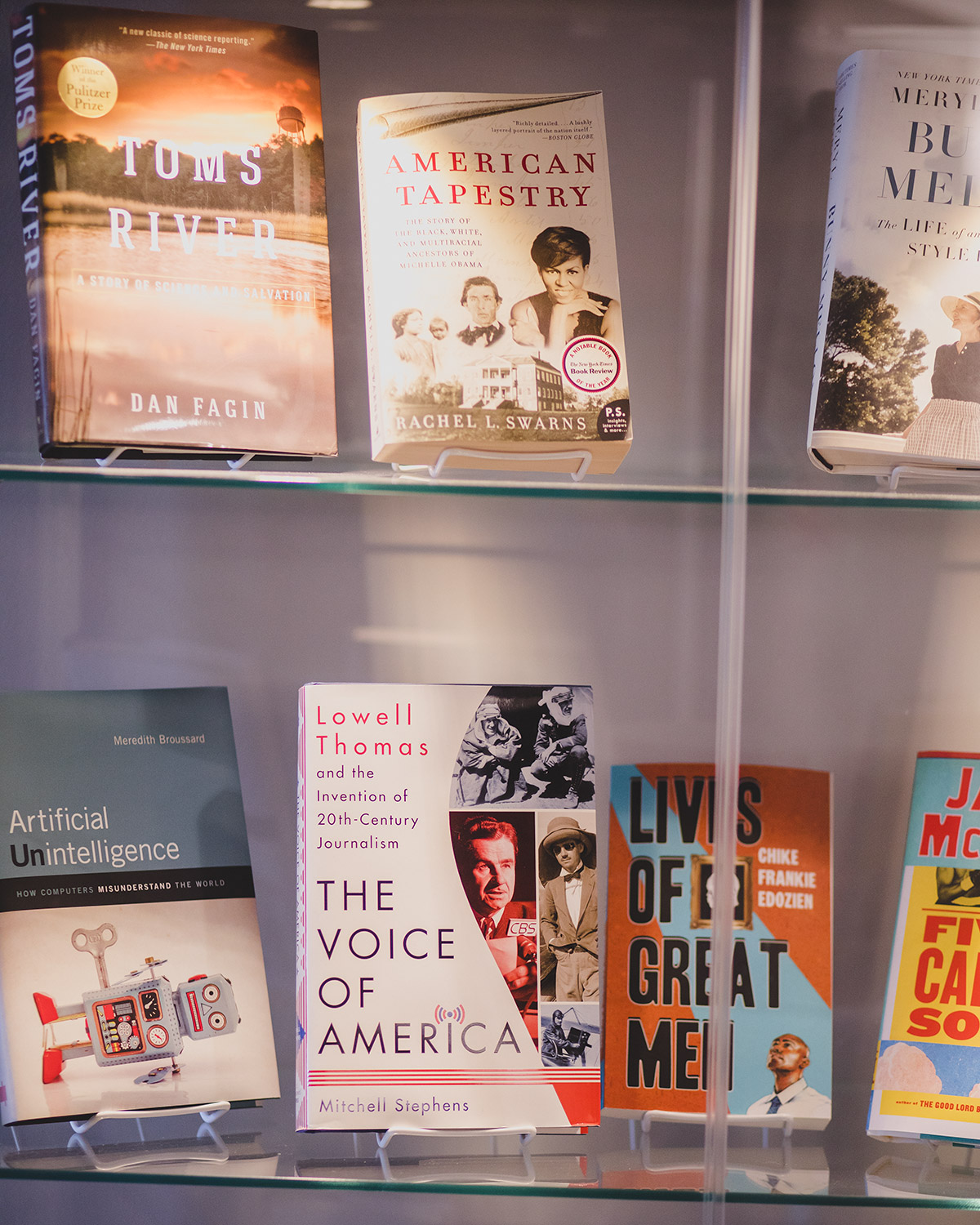
Dan FaginDan Fagin is the director of the Science, Health and Environmental Reporting Program, where he teaches Environmental Reporting and Current Topics in Science, Health and Environmental Journalism. The New York Times described his latest book, Toms River: A Story of Science and Salvation (2013), as "a new classic in science reporting." His recent bylines include The New York Times, Nature and Scientific American. For 14 years he was the environment writer at Newsday, where he was a principal member of two reporting teams that were finalists for the Pulitzer Prize. His stories on cancer epidemiology in 2003 won both of the best-known science journalism prizes in the United States, from the American Association for the Advancement of Science and the National Association of Science Writers. He is also the co-author of the book Toxic Deception (1997), which was a finalist for the Investigative Reporters and Editors book-of-the-year award. Fagin has been a Templeton-Cambridge Fellow in Science and Religion at Cambridge University and has also held fellowships at the Marine Biological Laboratory in Woods Hole, Massachusetts, and the Institute of Arctic Biology in Alaska. He is a former president of the 1,500-member Society of Environmental Journalists.
For more information about his books and articles, please see his website.
Stephen S. HallSteve Hall, who teaches Writing and Reporting Workshop I in SHERP, has been reporting and writing about science for nearly 30 years. In addition to numerous cover stories in the New York Times Magazine, where he also served as a Story Editor and Contributing Writer, his work has appeared in The New Yorker, The Atlantic Monthly, National Geographic, New York Magazine, Science, Scientific American, Discover, The Sciences, Hippocrates, Smithsonian, the Hastings Center Report, and Technology Review (where he wrote the “Biology, Inc.” column). He is also the author of six non-fiction books about contemporary science, including the critically acclaimed Invisible Frontiers (1987) and Merchants of Immortality (2003), which won the Science in Society Award from the National Association of Science Writers. In 2012 he was awarded a Guggenheim Fellowship, one of just three science writers so honored. Prior to writing about science, Hall wrote about sports for the Washington Post (1975), did foreign and financial reporting for the Journal of Commerce and other newspapers while based in Rome, Italy (1975-77), general assignment reporting for the San Francisco Chronicle (1977-1980), and award-winning travel writing for National Geographic Traveler and Travel & Leisure in the 1980s. He graduated with Honors in English Literature from Beloit College (1973). In addition to teaching at SHERP, he also teaches the Science Communication Workshops at NYU and has taught graduate seminars in science writing and explanatory journalism at Columbia University.
Stephen S. Hall teaches the Writing and Reporting Workshop II in the Science, Health and Environmental Reporting Program
Robin Marantz HenigRobin Marantz Henig is a freelance journalist, book author, and contributing writer for The New York Times Magazine. She has written nine books, most recently Twentysomething: Why Do Young Adults Seem Stuck? (co-authored with her daughter Samantha Henig) and Pandora’s Baby: How the First Test Tube Babies Sparked the Reproductive Revolution (about the early days of in vitro fertilization research). She co-edited the Field Guide for Science Writers, and articles of hers were chosen to be in the Best American Science Writing anthology in 2005 and 2007. Her articles have appeared in The New York Times Magazine, Civilization, Discover, OnEarth, Scientific American, Smithsonian, and just about every woman’s magazine in the grocery store. She also writes book reviews and opinion pieces for The New York Times and The Washington Post, and from 1998 to 2000 was a member of the board of contributors of USA Today. She served for ten years on the board of directors of the National Association of Science Writers, and is now the vice president.
Pandora’s Baby was named Book of the Year by the American Society of Journalists and Authors, and won the Science in Society Award of the National Association of Science Writers. Her previous book, The Monk in the Garden: The Lost and Found Genius of Gregor Mendel (Houghton Mifflin, 2000), was a finalist for a National Book Critics Circle award. In 2009, she received the career achievement award, its highest honor, from the American Society of Journalists and Authors, and received a Guggenheim Fellowship in 2010.
Robert Lee HotzRobert Lee Hotz is a science writer at The Wall Street Journal where he reports on new research and its impact on society. Mr. Hotz has covered science and technology for 30 years.
He is president of the Alicia Patterson Foundation, which funds independent journalism projects around the world. He is an elected Fellow of the American Association for the Advancement of Science (AAAS) and is a past president of the National Association of Science Writers.
Professor Hotz is among America's most respected science journalists. He was a Pulitzer Prize finalist in 1986 for his coverage at The Atlanta Journal-Constitution of the legal, moral and social impacts of genetic engineering, and again in 2004 for his coverage at The Los Angeles Times of the space shuttle Columbia accident. Mr. Hotz shared in The Los Angeles Times’ 1995 Pulitzer Prize for articles about the Northridge Earthquake. He has received many other honors, including national awards from AAAS, The Society of Professional Journalists, and the American Geophysical Union. He has traveled widely in Antarctica and the Arctic, including four trips to the South Pole.
Apoorva MandavilliApoorva Mandavilli, the internship coordinator at SHERP, is the director and executive editor of SFARI.org, the leading website for autism research news. She conceived and launched this website for The Simons Foundation, the largest non-governmental source of funding for autism research. Prior to that, she was senior news editor of the prominent biomedical journal Nature Medicine, During her stint there, she reported on the ground in Asia, Africa, Europe and the U.S., primarily about infectious diseases and neuroscience, and wrote an opinion column for Nature’s news website. She has also worked as U.S. news editor of the online publication BioMedNet News, as health editor for the New York Times-owned website About.com, as a reporter for a weekly newspaper, and has dabbled in radio journalism. She has an M.S. in biochemistry from the University of Wisconsin-Madison and graduated from SHERP in 1999. Her work has been featured in a variety of media outlets, including Nature, Discover, Technology Review, Women's Health, O, The Oprah Magazine and National Public Radio's Science Friday.
Ivan Oransky, MDIvan Oransky, MD has taught medical reporting in the Science, Health and Environmental Reporting Program since 2002. He is executive editor of Reuters Health. Previously, he was managing editor, online, at Scientific American, where he oversaw dramatic growth in website traffic and engagement. From 2002 to 2008, he was at The Scientist, first as web editorial director and then as deputy editor. Under his leadership, the editorial team of The Scientist won numerous awards, including the 2008 American Society of Business Publication Editors' Magazine of the Year and Gold Eddie Awards for science magazines from FOLIO in consecutive years. He has also served as founding editor in chief of Praxis Post, an online magazine of medicine and culture which was a finalist for the 2001 Online News Association Award for General Excellence in its first year of publication. Oransky is the author or co-author of four books, including The Common Symptom Answer Guide (McGraw-Hill, 2004), and has written for numerous publications including the Boston Globe, The Lancet, The New Republic, and the Wall Street Journal Online. He received his BA at Harvard and his MD from NYU, and completed an internship at Yale. During medical school, he was co-editor-in-chief of the student section of the Journal of the American Medical Association. He has served on the board of directors of the Association of Health Care Journalists since 2002, and as AHCJ treasurer since 2009. Ivan also holds an appointment at NYU Medical School as Clinical Assistant Professor of Medicine, and has taught at the City University of New York's Graduate School of Journalism.
Kevin QuealyKevin Quealy co-teaches the data journalism class at SHERP. A graphics editor at the New York Times since 2008, he has also worked at the Philadelphia Inquirer and the St. Louis Post-Dispatch newspapers, and was a Peace Corps volunteer in South Africa from 2004 to 2006, working as a teacher and in curriculum implementation. He has a master's from the Missouri School of Journalism and a B.A. in physics
from Gustavus Adolphus College in St. Peter, Minn.
John RennieJohn Rennie teaches Science Writing in the Science, Health and Environmental Reporting Program. He served as editor in chief of Scientific American for almost 15 years, having been a member of its Board of Editors since 1989. During his tenure he oversaw the modernization and expansion of that venerable magazine franchise to include new titles such as Scientific American Mind and assorted digital media. He edited the National Magazine Award-winning single-topic issues "What You Need to Know about Cancer" (Sept. 1996) and "A Matter of Time" (Sept. 2002). The Potomac Institute for Policy Studies honored him with its 2003 Navigator Award for distinguished service in support of national science and technology policy. He was also a recipient of the 2000 Sagan Award for Public Understanding of Science from the Council of Scientific Society Presidents. Rennie received his bachelor of science degree from Yale University in 1981, after which he worked for several years in a laboratory at Harvard Medical School before embarking on his career as a science writer. His writing has appeared in The Economist, The New York Times and other publications. His numerous television and radio appearances include PBS Newshour with Jim Lehrer, ABC News Overnight, CBS Early Show, History Channel's Clash of the Cavemen, Discovery Channel’s Apocalypse How and NPR’s Science Friday. As a frequent public speaker, Rennie has appeared before audiences as diverse as those at the Massachusetts Institute of Technology, the University of Tennessee School of Journalism; he has also been featured twice at the World Life Sciences Forum, the BIO International Conference and many other meetings.
Charles SeifeBefore joining the Department of Journalism, Charles Seife was writer for Science magazine -specializing in physics and mathematics- and had been a U.S. correspondent for New Scientist. He holds an A.B. in mathematics from Princeton University, an M.S. in mathematics from Yale University, and an M.S. in journalism from Columbia University. His research interests include science and mathematics journalism.
Seife's freelance work has appeared in The Economist, Scientific American, The Philadelphia Inquirer, The Washington Post, The New York Times and other publications. He is also the author of Zero: The Biography of a Dangerous Idea (2000), which won the 2000 PEN/Martha Albrand Award for First Nonfiction, as well as Alpha & Omega: The Search for the Beginning and End of the Universe (2003), Decoding the Universe: How the New Science of Information is Explaining Everything in the Cosmos, From Our Brains to Black Holes (2005), Sun in a Bottle: The Strange History of Fusion and the Science of Wishful Thinking (2008), and the forthcoming Proofiness: The Dark Arts of Mathematical Deception (2010).
Bora ZivkovicBora Zivkovic is the blog editor at Scientific American. Born in Belgrade, he studied veterinary medicine at University of Belgrade. Upon arrival in the U.S., he did research on circadian rhythms in Japanese quail at North Carolina State University. Together with Anton Zuiker, he organizes the popular annual ScienceOnline conferences in Triangle region of North Carolina. He is the series editor of Open Laboratory, the annual anthology of the best science writing on the Web. Zivkovic lives out in the country halfway between Chapel Hill and Pittsboro, North Carolina, using the power of internet to his advantage: being connected to the world while enjoying the natural surroundings. He blogs at A Blog Around the Clock and tweets as @BoraZ. The Science, Health and Environmental Reporting Program and Studio 20 co-sponsored this appointment.